
Aug 12, 2026
How to Read Your Volleyball Team's Defensive Stats
How to Read Your Volleyball Team's Defensive Stats
Offense gets the highlight reel. Defense is what actually wins close sets — and it's the side of the stat sheet most coaches read the least carefully.
We already broke down this team's offense in How to Analyze Volleyball Stats — same 50–39 win, same match. This time, we're looking at the other half of the box score: who kept the ball alive, who won at the net, and where rallies actually got decided.
Start with the shape of the defense
Before looking at individual players, get the team-level picture.

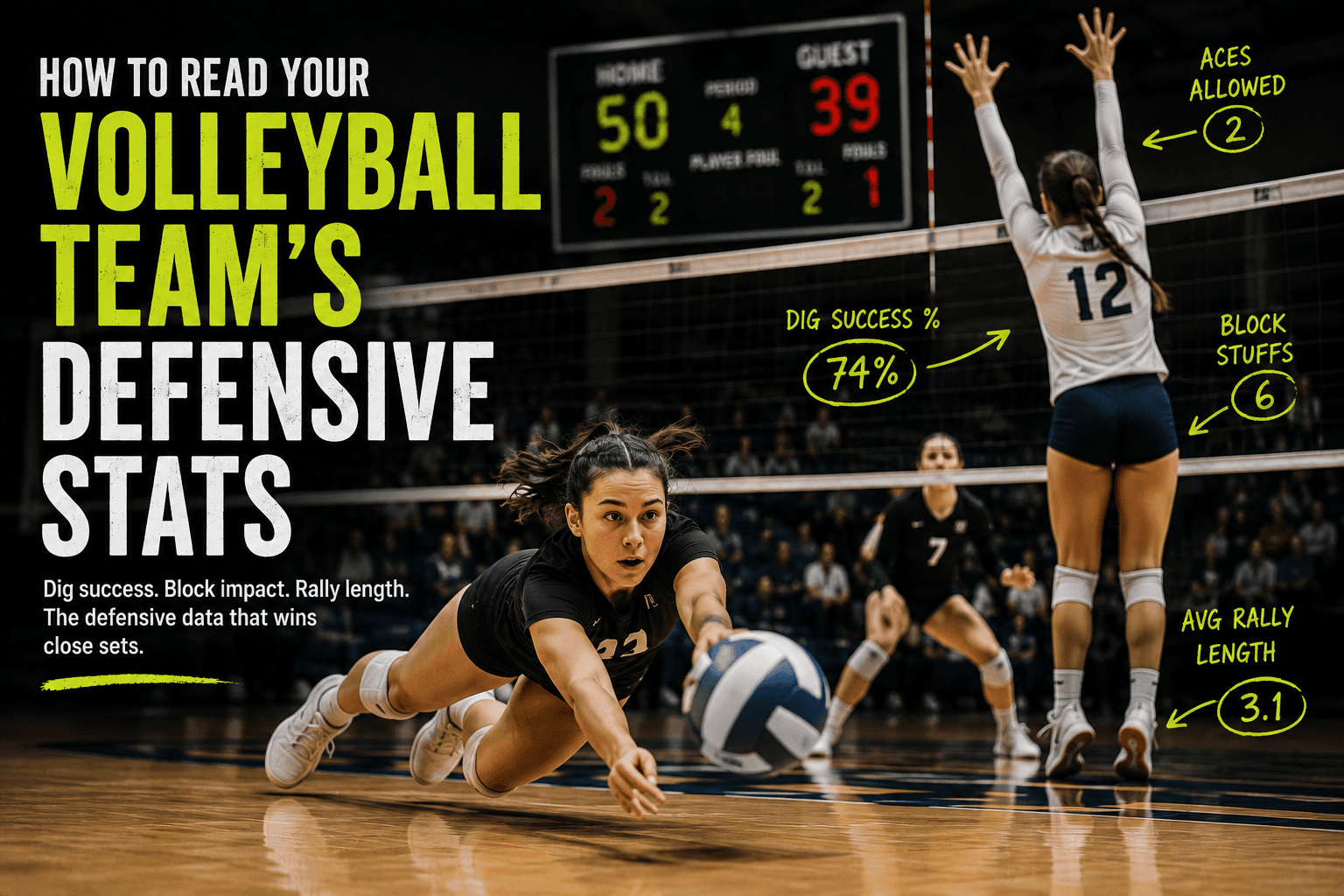
23 successful digs, 5 dig errors, 6 block stuffs, 14 total block contacts, only 2 aces allowed across 40 opponent serves, and an average rally length of 3.1 contacts (longest: 12).
See the full page of stats here.
Two things jump out immediately. First, only 2 aces allowed — this team's serve-receive is clearly solid, which tracks with the pass ratings we saw in the original breakdown. Second, a 3.1-contact average rally length is short — points are ending fast, in either direction, which is worth keeping in mind for the rally-length data further down.
Find your most (and least) reliable defender
Not every dig is equal, and volume alone doesn't tell you who to trust in a scramble.
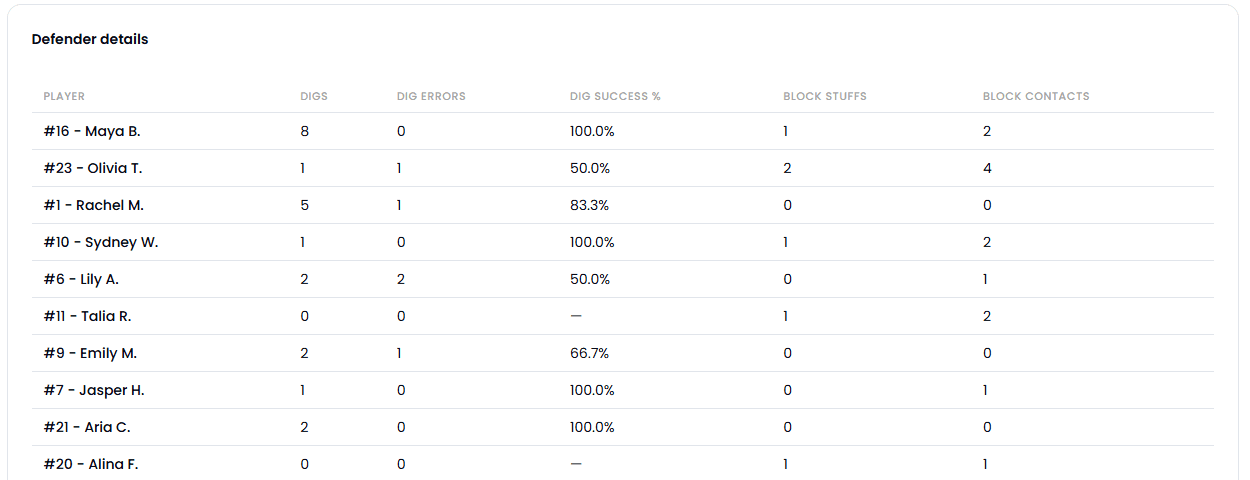
Maya B. is the clear standout: 8 digs at a 100% dig success% — the highest volume and the highest success rate on the team, with zero errors. Compare that to Olivia T. and Lily A., who are both sitting at just 50% success.
This is the kind of gap a coach feels in a match but rarely sees quantified. Maya B. isn't just getting to more balls — she's converting nearly all of them into playable digs. Olivia T. and Lily A. are each touching the ball roughly as often as some of their teammates, but only successfully controlling half of those touches. That's not necessarily a talent gap — it's often a positioning or read-timing issue, and it's specific enough to actually drill.
Blocking: contacts vs. stuffs
Getting a hand on the ball and actually stopping the point are two different skills, and the stats separate them cleanly.
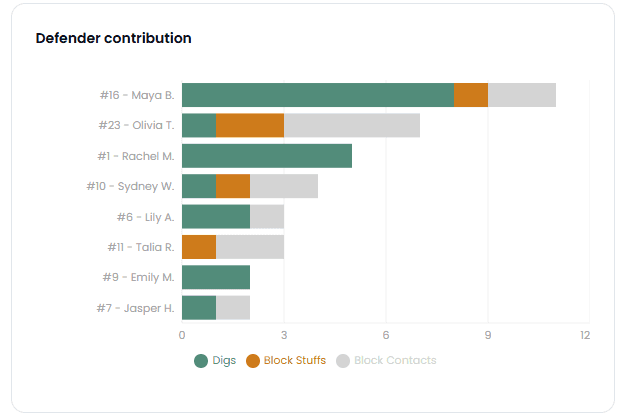
Olivia T. leads the team in both block stuffs (2) and total block contacts (4) — she's getting to the ball at the net more than anyone and converting a solid share of those touches into stops. Maya B., meanwhile, is doing more of her damage on defense than at the net — she's a digging specialist first.
The distinction matters for how you deploy players. A blocker who touches a lot of balls but rarely stuffs them is still valuable — every contact slows the attack down and gives the defense a better shot at the next play — but it's a different skill profile than a player who converts touches into outright points. Knowing which type each of your blockers is changes how you'd scheme a rotation against a strong opposing hitter.
Where rallies actually get decided
This is the piece that connects individual defensive stats back to what actually shows up on the scoreboard.
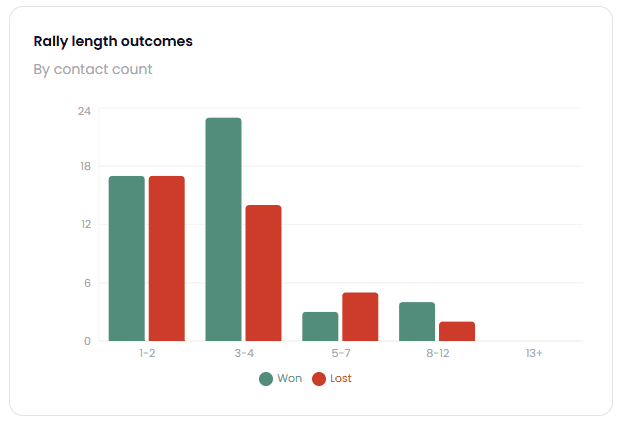
The team wins more short rallies (1–4 contacts) than it loses. In the 5–7 contact range, the margin flips slightly in the opponent's favor. But in extended rallies (8–12 contacts), the team wins clearly more than it loses — a sign the defense holds up, and arguably improves, the longer a point goes.
That last point is worth sitting with: a lot of coaches assume long rallies favor whichever team is more athletic or better conditioned, and treat extended points as a coin flip at best. Here, the data says otherwise — this team's digs and transition defense are actually an asset in longer exchanges, not a liability. That's a strength worth knowing you have, not just a stat to note in passing.
One actionable change for next practice
From this single match, the clearest takeaway isn't a weakness — it's a concentration risk. Maya B. is carrying an outsized share of the defensive workload (highest digs, highest success%, and she's one of the team's two primary setters based on set-attempt volume). That's a lot of responsibility sitting on one player.
The drillable version of that insight: rather than "get better at defense" as a vague team goal, the specific move is targeted reps for Olivia T. and Lily A. on read-and-move timing in the back row — closing that 50%-to-100% success gap with Maya B. would meaningfully reduce how much the defense depends on one player carrying the floor.
Curious how your own team's defense breaks down, player by player? Check out pricing for our Individual & Team Plans
Try it on your own team
Every stat in this breakdown — dig success%, block contacts vs. stuffs, rally length outcomes — comes from the same tagged match footage as the original post. No manual charting, no separate defensive stat sheet to maintain.
This is the second post in our ongoing breakdown series. Next up: a setter-focused read on the same match.


